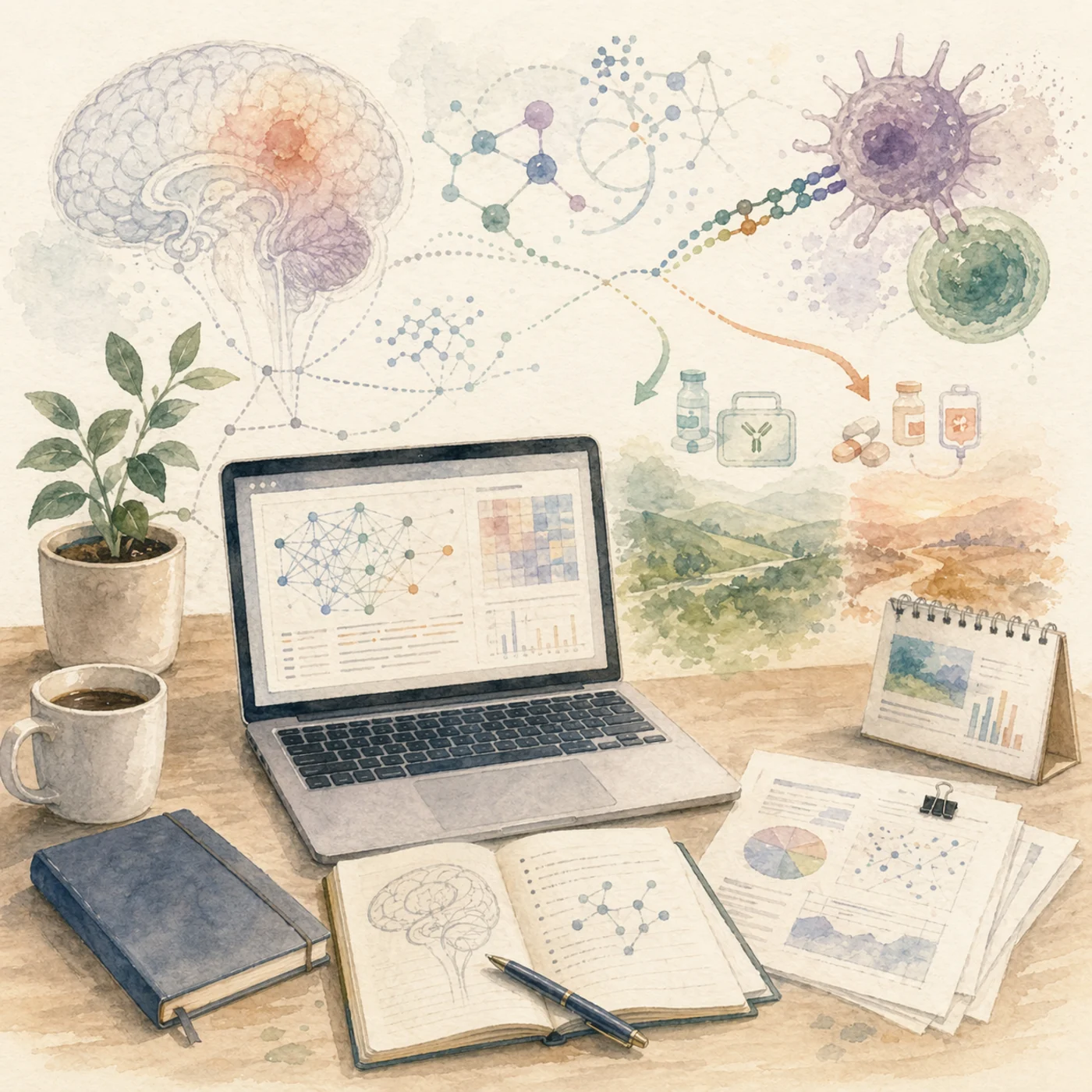
What may be driving it
Mutations, copy-number changes, fusions, and expression — ranked by evidence.
flip ↷Strong findings kept separate from uncertain signals, so nothing gets overstated.
You were handed reports full of genes, variants, and acronyms — and a few rushed minutes to make sense of them. Command Center is the second set of eyes: it reads all of it and turns it into clear questions for your oncology team.
Built for second opinions · complex or rare cases · an honest read of what's strong, weak, or unproven.
I found that my cancer overexpresses DLL3 — immunosuppressive, but not featureless. That changed my question from "what does the report say?" to "what might we be missing?" — signals I took to my oncologists, not conclusions I acted on alone.
Built for that moment, by someone who needed it himself. One person's experience; not a promise of findings for anyone.
Sequencing, genomics reports, labs, pathology — no bioinformatics needed.
Your DNA, RNA, and immune signals are analyzed; AI summarizes the results.
A doctor-ready report — strong signals separated from weak.
A real report from the founder's own cancer data. Open it before you pay — yours reads differently, but the structure is the same.
The same open tools cancer researchers use, on GRCh38 — then an AI layer weighs the evidence and writes it in plain language, every finding tied to its source.
Mutect2MuSEVEPSTARSalmonArribaPureCNFACETSOptiTypeMHCflurryDepMaptrialsevidence-weightedcitedMore data means a deeper analysis — but you don't need to understand the formats. Most hospitals release your files on request.
A cancer genomics report from your hospital or testing company.
VCF · BAM · CRAM · FASTQ plus matched normal data, which enables germline findings.
Anything describing the diagnosis, tissue, markers, or treatments.
One-time fee, no subscription. Read the full sample report before you pay.
Analysis from your existing genomics report.
The complete pipeline on your raw sequencing files.
VCF · BAM · CRAM · FASTQEverything in Full, plus a 1:1 walkthrough of your report.
One-time fee, no subscription. Full refund if we can't process your files; otherwise non-refundable once your report runs — so read the sample first.
Checkout and upload happen on our secure analysis portal, hosted on AWS.
No — an educational and research tool, not a medical device, diagnosis, or treatment plan. Review every finding with your oncology team before acting.
No. Your files run through a real genomics pipeline — the same open tools used in cancer research (Mutect2, MuSE, VEP, STAR, MHCflurry, DepMap), with mutations called from the consensus of two tools. AI weighs the evidence and writes it in plain language, every claim tied to its source.
It's analyzed in our own pipeline — not handed to a third party to do the genomics. Never sold, shared, or used to train AI, and you can delete it permanently at any time.
If you include matched normal-tissue data, it can surface inherited (germline) signals that may affect blood relatives — and rarely, unexpected family relationships. It isn't designed to diagnose inherited conditions; confirm any inherited finding with a genetic counselor.
Existing tumor sequencing — ideally with matched normal data — plus any lab or pathology reports. It analyzes data you already have; it doesn't generate new sequencing.
The pipeline runs automatically once your files are uploaded. Most reports are ready within a few days; we email you when yours is done.
Some cases carry fewer signals. The report still organizes what's there and flags the gaps — no finding is ever guaranteed, and that honesty is the point.
Full refund if your files can't be processed. Once a report is generated the fee is non-refundable, since the analysis has run — which is why the complete sample is here to read first.
Read the free sample report, then run the analysis on your own files.
Cancer Command Center is an educational and research tool — not a medical device, a diagnosis, or a substitute for professional medical advice, and not FDA-cleared. Always review any finding, treatment idea, or research-stage suggestion with your oncology team before acting.